Quick answer
Microgreens contain protein, but they are generally used as vegetables or garnishes—not as replacements for legumes, eggs, dairy, fish, meat, soy foods, or other established protein sources. A “highest-protein microgreen” ranking is trustworthy only when crops were measured in the same laboratory, on the same fresh-weight basis, at comparable harvest stages.
The comparison traps
Protein rankings often fail because they mix:
- dry seeds with water-rich shoots;
- dry-weight and fresh-weight results;
- sprouts and microgreens;
- different laboratories and protein methods;
- 100 g values with tiny garnish portions;
- crude protein estimates with complete amino-acid claims.
The protein per 100 g guide explains these errors in detail.
Which crops are practical candidates?
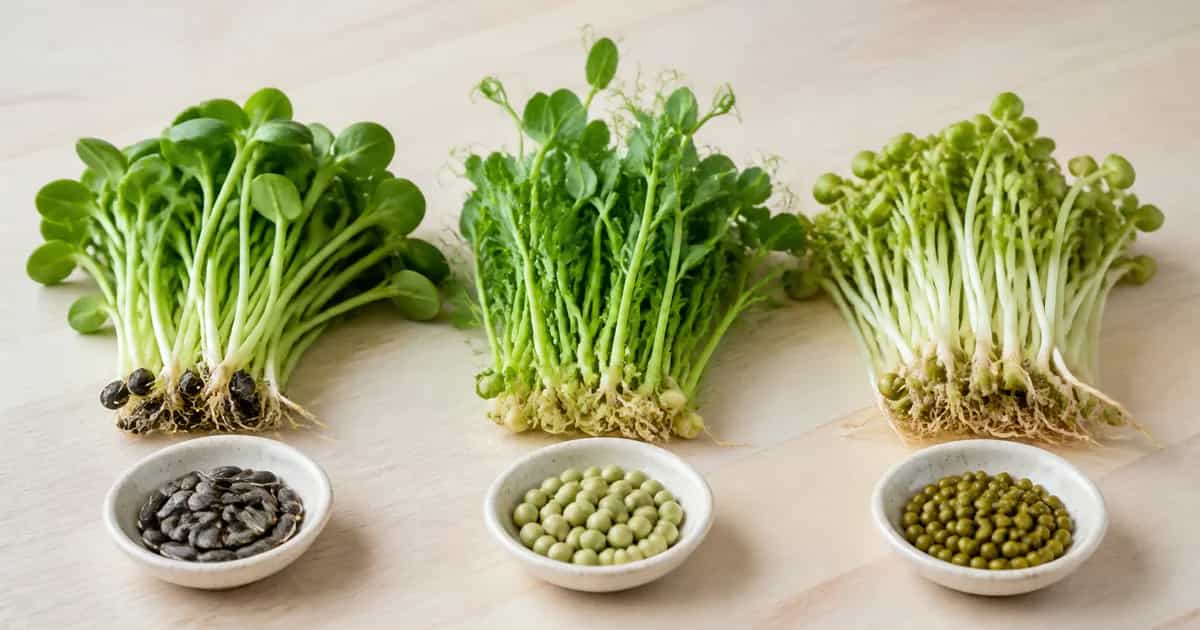
Larger-seeded crops such as sunflower, pea, and mung bean produce substantial shoots and are reasonable candidates for a more filling plate. That does not prove they are all legally “high protein” or that one always outranks the others.
| Crop | Practical advantage | Evidence caution |
|---|---|---|
| Sunflower | Thick stems, broad leaves, nutty texture | Do not copy dry sunflower-seed protein. |
| Pea shoots | Large edible volume, mild sweetness | Dry pea and fresh shoot values differ. |
| Mung bean | Crisp legume shoot | Sprout and microgreen stages are often mixed. |
| Brassicas | Easy to add broadly | A small garnish contributes a small absolute amount. |
Read the crop guides for sunflower, pea, and mung bean.
Protein quality and servings
Total protein grams do not fully describe amino-acid balance or digestibility. Claims such as “complete protein” need direct compositional evidence and a realistic serving. Even a favorable per-100 g result contributes less when the usual serving is a small handful.
For meal planning, treat microgreens as a complement. Put them on lentils, beans, tofu, eggs, yogurt, fish, chicken, or a grain-and-legume bowl rather than asking the greens to carry the protein target alone.
See microgreen meal ideas, carbs and macros, and recipes.
How to compare a label
Use the same serving size, verify fresh weight, and check whether protein was directly measured. If a product makes a formal “high protein” claim, evaluate it under the labeling rules that apply in your country.
Bottom line
Sunflower, pea, and mung bean microgreens can add more substance than delicate garnishes, but no universal ranking is defensible from mixed datasets. Build protein around established foods and use microgreens for freshness, flavor, and diversity.