Quick answer
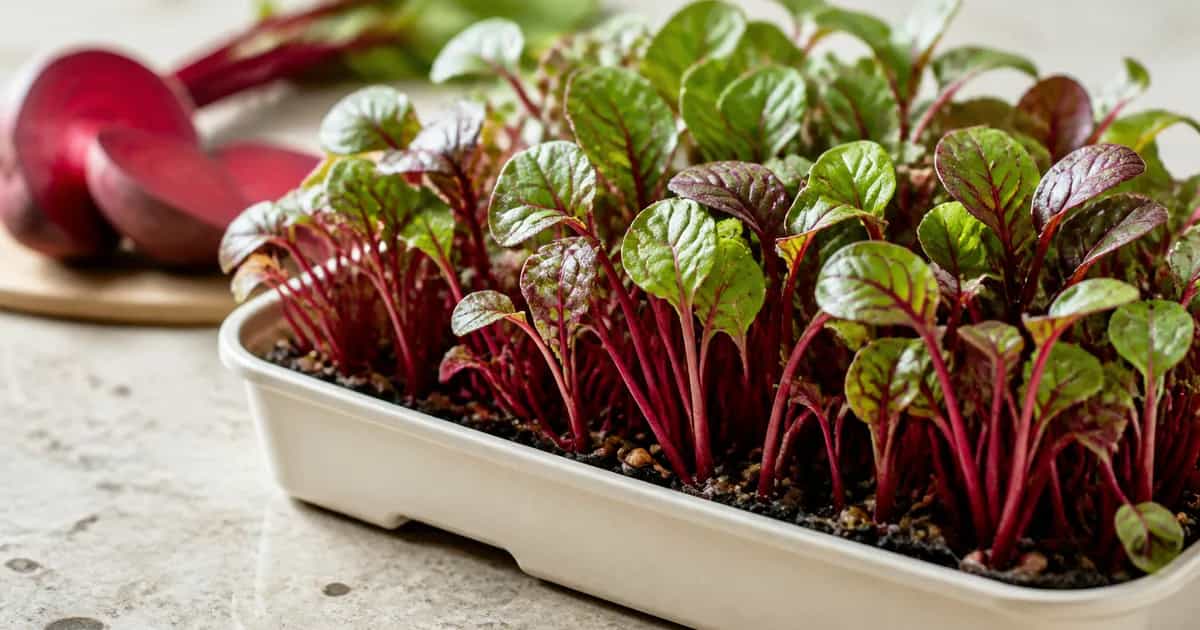
Beet microgreens provide a fresh plant food with measurable vitamin C, minerals, sugars, and bioactive pigments in published experiments. Their ruby stems and red-green leaves reflect pigment chemistry, but color alone does not tell you an exact nutrient dose or prove a health outcome.
What studies report
Beetroot microgreens have appeared in controlled comparisons with other crops. Researchers have measured dry matter, acidity, sugars, organic acids, vitamin C, minerals, phenolics, and antioxidant activity. One six-crop study reported fresh-weight vitamin C and mineral results for red beet alongside broccoli, radish, pea, sunflower, and bean.
The useful lesson is variation: the tested beet sample can be described precisely, while “all beet microgreens” cannot. For a reliable table, record cultivar, medium, nutrient solution, light, temperature, harvest age, sample preparation, and unit.
Use the nutrition chart reading guide before comparing beet data with another species.
What the red color means
Beet color is associated with betalain pigments. Pigment presence is a botanical feature; it is not a shortcut to a clinical claim. Antioxidant assays performed in a laboratory also do not automatically predict a disease-prevention effect in people.
This distinction matters whenever an article moves from “contains a measured compound” to “will produce a health result.” Our healthy microgreens guide explains how to read that jump.
Why values change
- Different beet cultivars can have different pigment and nutrient profiles.
- More water in the harvested tissue lowers many per-100 g fresh-weight concentrations.
- Light spectrum and intensity can affect plant metabolism and color.
- Harvest stage changes the ratio of stem, cotyledon, and true leaf.
- Dry-weight data look numerically larger because water has been removed.
Never combine a dry-weight mineral value with a fresh-weight calorie or vitamin value in the same “100 g” row unless every basis is clearly converted.
Serving and use
Beet microgreens have an earthy, mild flavor and strong visual contrast. Add a small handful to salads, cheese toast, grain bowls, roasted vegetables, or cold plates. Their color can bleed slightly when wet, so add them just before serving.
Explore microgreens in everyday meals, the taste guide, and the complete recipe collection. For calorie and macro interpretation, use the calorie guide instead of borrowing mature beet values.
Grow and choose them
Beet can germinate more slowly and unevenly than beginner-friendly radish. Start with clean seed, an even medium, patient moisture control, and good airflow. The beet variety profile, germination troubleshooting guide, and watering guide cover the practical details.
Bottom line
Beet microgreens are colorful, edible seedlings with research-measured nutrients and pigments. Use study values only within their stated conditions, and treat color as a sensory and botanical feature—not a guaranteed health dose.