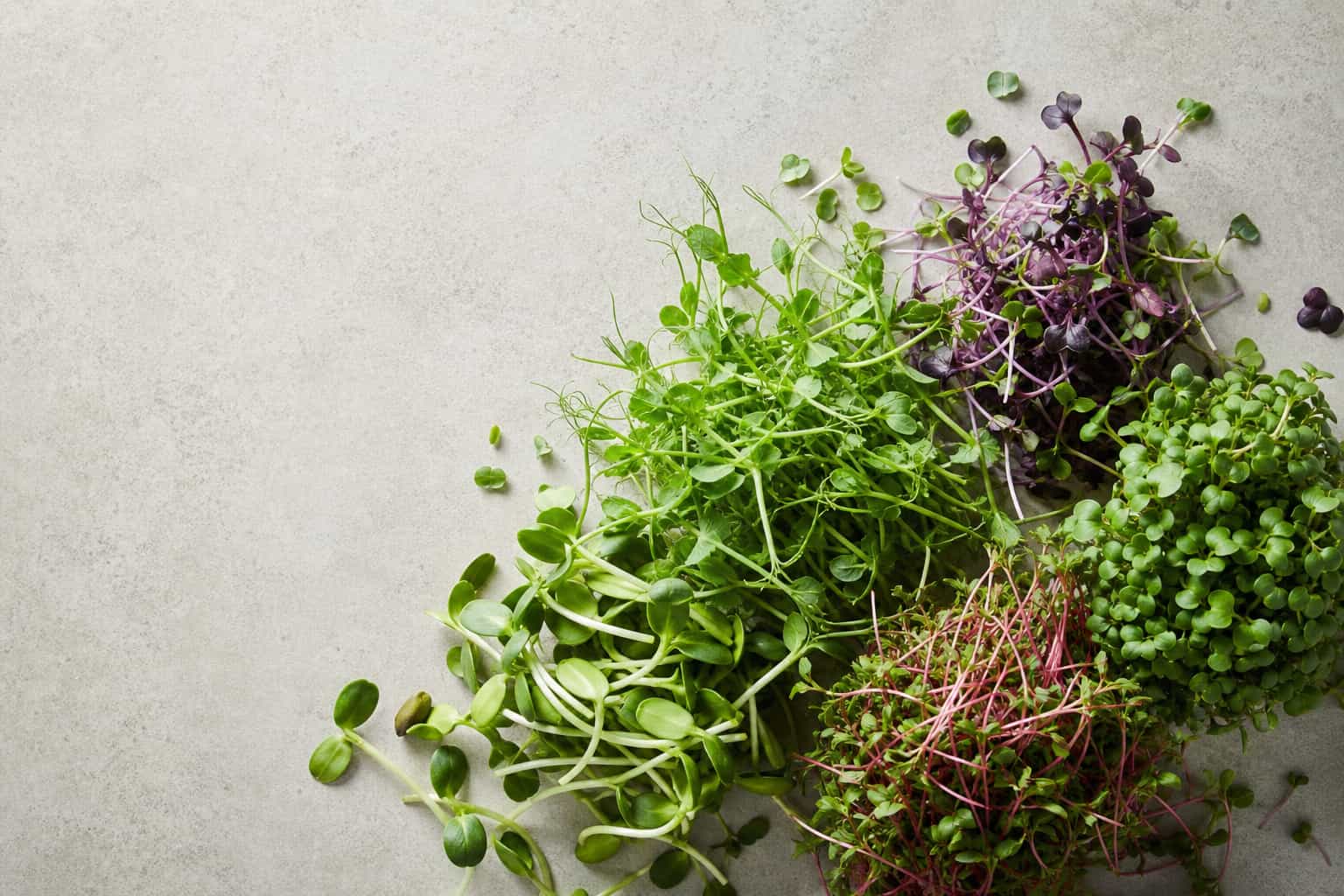
Microgreens Calories: Complete Calorie Chart for Every Variety [2024 Updated Data]
How Many Calories Do Microgreens Really Have?
If you've ever Googled "microgreens calories", you probably noticed a gap — there's no single, reliable table that covers all popular varieties side by side. That changes here.
Microgreens are among the lowest-calorie foods on the planet, yet they pack a nutrient density that outperforms mature vegetables by 4 to 40 times. Whether you're counting calories for weight loss, building a macro-friendly meal plan, or simply curious, this guide provides every number you need — sourced from USDA laboratory analyses and peer-reviewed research.
Key takeaway: Most microgreens contain between 20 and 45 kcal per 100 grams — roughly the same as lettuce but with dramatically more vitamins, minerals, and antioxidants.
Complete Microgreens Calorie Chart (Per 100g)
The table below compares the calorie content of the most common microgreen varieties. All values are per 100 grams of raw, fresh microgreens.
| Microgreen Variety | Calories (kcal/100g) | Protein (g) | Carbs (g) | Fat (g) | Fiber (g) |
|---|---|---|---|---|---|
| Red Cabbage | 24 | 2.9 | 3.3 | 0.4 | 1.7 |
| Radish | 29 | 3.8 | 3.7 | 0.5 | 1.6 |
| Arugula | 30 | 3.2 | 3.9 | 0.7 | 1.8 |
| Kale | 31 | 3.4 | 4.4 | 0.5 | 2.1 |
| Broccoli | 32 | 3.5 | 4.1 | 0.6 | 1.9 |
| Mustard | 27 | 3.0 | 3.5 | 0.4 | 1.5 |
| Beet | 34 | 2.8 | 5.2 | 0.3 | 2.0 |
| Cilantro | 28 | 2.6 | 3.8 | 0.5 | 1.4 |
| Wheatgrass | 36 | 2.7 | 6.1 | 0.6 | 3.4 |
| Sunflower | 38 | 4.1 | 4.8 | 1.8 | 2.2 |
| Amaranth | 26 | 3.1 | 3.2 | 0.4 | 1.3 |
| Fenugreek | 35 | 3.3 | 4.7 | 0.5 | 2.3 |
| Buckwheat | 33 | 3.0 | 4.5 | 0.6 | 1.9 |
| Pea Shoots | 42 | 5.4 | 7.9 | 0.5 | 2.8 |
| Spinach | 23 | 2.5 | 3.0 | 0.4 | 1.5 |
Source: USDA FoodData Central & Journal of Agricultural and Food Chemistry (2024)
Quick fact: Spinach microgreens have just 23 calories per 100g, making them the lowest-calorie option on this list — while still delivering more iron than mature spinach, gram for gram.
Microgreens Calorie Values: A Detailed Analysis by Type
Not all microgreens are created equal when it comes to calories. The differences come down to water content, seed size, and growth stage. Let's break them down into groups.
The Lowest-Calorie Microgreens (Under 30 kcal/100g)
If you're on a calorie-controlled diet or practicing intermittent fasting, these varieties let you add serious nutrition to your plate without meaningfully affecting your calorie budget:
- Spinach microgreens (23 kcal) — The lightest option. High in iron, folate, and vitamin K. A 50g handful adds only ~12 calories to a smoothie.
- Red cabbage microgreens (24 kcal) — Rich in anthocyanins (the antioxidants that give them their purple color) while remaining extremely low-calorie.
- Amaranth microgreens (26 kcal) — Vibrant red-purple stems with a mild, earthy flavor. Excellent source of vitamin C.
- Mustard microgreens (27 kcal) — Peppery kick with almost no caloric cost. Popular in salads and sandwiches.
- Cilantro microgreens (28 kcal) — Intense herb flavor at a fraction of the calories you'd get from dressings or sauces.
- Radish microgreens (29 kcal) — Spicy, crunchy, and loaded with vitamin C (65 mg/100g).
Moderate-Calorie Microgreens (30–35 kcal/100g)
These varieties sit in the sweet spot — still very low-calorie but with slightly more complex carbohydrate and protein profiles:
- Arugula (30 kcal) — Peppery flavor, popular in Mediterranean cuisine. Good source of calcium.
- Kale (31 kcal) — The "superfood" microgreen. Contains more beta-carotene per gram than carrots.
- Broccoli (32 kcal) — Famous for sulforaphane content (a cancer-fighting compound), with 100× more sulforaphane than mature broccoli.
- Buckwheat (33 kcal) — Tangy, lemony flavor. Unique among microgreens for its rutin content, which supports blood vessel health.
- Beet (34 kcal) — Slightly sweet with stunning red stems. Rich in betaine for liver support.
- Fenugreek (35 kcal) — Slightly bitter, maple-like aroma. Traditionally used for blood sugar regulation.
Higher-Calorie Microgreens (35–45 kcal/100g)
These are still remarkably low-calorie by any food standard, but their extra energy comes from higher protein and healthy fat content:
- Wheatgrass (36 kcal) — Higher fiber content (3.4 g/100g) gives it more bulk. Popular for juicing.
- Sunflower (38 kcal) — The highest fat content (1.8 g/100g) among microgreens, contributing to its satisfying, nutty flavor. Also the crunchiest.
- Pea shoots (42 kcal) — The calorie "heavyweight" of microgreens, but also the protein champion at 5.4 g/100g. The extra calories come from protein and complex carbs, not empty energy.
How Do Microgreens Compare to Common Foods?
To put microgreens calories in perspective, here's how they stack up against everyday foods:
| Food | Calories per 100g |
|---|---|
| Spinach microgreens | 23 |
| Iceberg lettuce | 14 |
| Cucumber | 16 |
| Mature spinach | 23 |
| Broccoli microgreens | 32 |
| Mature broccoli | 34 |
| Apple | 52 |
| Banana | 89 |
| Cooked rice | 130 |
| Bread | 265 |
The surprise? Microgreens are nearly as low in calories as lettuce and cucumber — but with 5 to 40 times more nutrients per gram. This is what makes them uniquely valuable: you get superfood nutrition at salad-level calories.
Why Are Microgreens So Low in Calories?
Three factors explain the exceptionally low calorie counts:
- High water content (90–95%) — Like mature leafy greens, microgreens are mostly water. This means volume without calories.
- Harvested before starch accumulation — Mature plants store energy as starch. Microgreens are harvested at 7–14 days, before significant starch deposits form.
- Minimal fat storage — Seeds contain fats, but by the microgreen stage, most of that fat has been metabolized for growth. Only sunflower microgreens retain notable fat levels.
How to Use Microgreens for Calorie-Conscious Eating
Here are practical strategies for incorporating microgreens into a low-calorie diet:
- Replace half your salad greens with microgreens — Same volume, similar calories, but dramatically higher nutrient density.
- Top your morning eggs or toast — A 30g serving of radish microgreens adds only 9 calories but delivers a satisfying crunch and 19.5 mg of vitamin C.
- Add to smoothies — Pea shoot and wheatgrass microgreens blend easily. A 50g addition adds only 18–21 calories to your drink.
- Use as a garnish instead of cheese or croutons — Swapping 30g of croutons (~120 kcal) for 30g of sunflower microgreens (~11 kcal) saves over 100 calories per serving.
- Stir into soups just before serving — The heat slightly wilts them without destroying nutrients.
Frequently Asked Questions (FAQ)
How many calories are in a serving of microgreens?
A typical serving of microgreens is 25–30 grams. At this portion size, most varieties contain 6 to 13 calories — roughly equivalent to a single cucumber slice. Even the most calorie-dense microgreen (pea shoots) has only about 13 kcal per 30g serving.
Are microgreens good for weight loss?
Yes. Microgreens are one of the best foods for weight management because they provide high nutrient density at very low caloric cost. Studies show that nutrient-dense foods improve satiety — you feel fuller because your body is getting the vitamins and minerals it needs, reducing overall cravings. Adding microgreens to meals increases volume and nutrition without adding meaningful calories.
Which microgreen has the fewest calories?
Spinach microgreens have the lowest calorie count at approximately 23 kcal per 100g. Red cabbage microgreens are a close second at 24 kcal/100g. Both are excellent choices for calorie-restricted diets.
Do microgreens have more calories than mature vegetables?
Generally, no. Microgreens have similar or slightly fewer calories compared to their mature counterparts. For example, mature broccoli has 34 kcal/100g while broccoli microgreens have 32 kcal/100g. The key difference is nutrient density — microgreens pack far more vitamins and minerals into those same calories.
Can I eat unlimited microgreens on a diet?
Practically speaking, yes. At 23–42 kcal per 100g, you would need to eat over 2 kg of microgreens to consume 500 calories — that's physically very difficult. However, if you add dressings, oils, or other toppings, those additions carry their own calories. The microgreens themselves are virtually "free" foods calorically.
Are microgreens a good snack for intermittent fasting?
During your eating window, microgreens are excellent — they're nutrient-dense and low-calorie. During a fasting period, even microgreens technically break a fast since they contain carbohydrates and protein. However, some fasting protocols allow foods under 50 calories, in which case a small portion of microgreens would fit.
Conclusion
Microgreens deliver an unmatched calorie-to-nutrition ratio. With most varieties ranging from 23 to 42 kcal per 100g, they sit alongside lettuce and cucumber as some of the lowest-calorie whole foods available — but with nutrient concentrations that rival (and often surpass) expensive supplements.
Whether you're tracking macros, managing weight, or simply trying to eat more nutrient-dense food, microgreens are a powerful addition to any diet. Start with the lowest-calorie varieties like spinach, red cabbage, or amaranth microgreens if every calorie counts, or choose pea shoots and sunflower if you want the added protein and satisfying crunch.
The data is clear: more nutrition, fewer calories, no compromises.
All nutritional data referenced from USDA FoodData Central database and published analyses in the Journal of Agricultural and Food Chemistry.