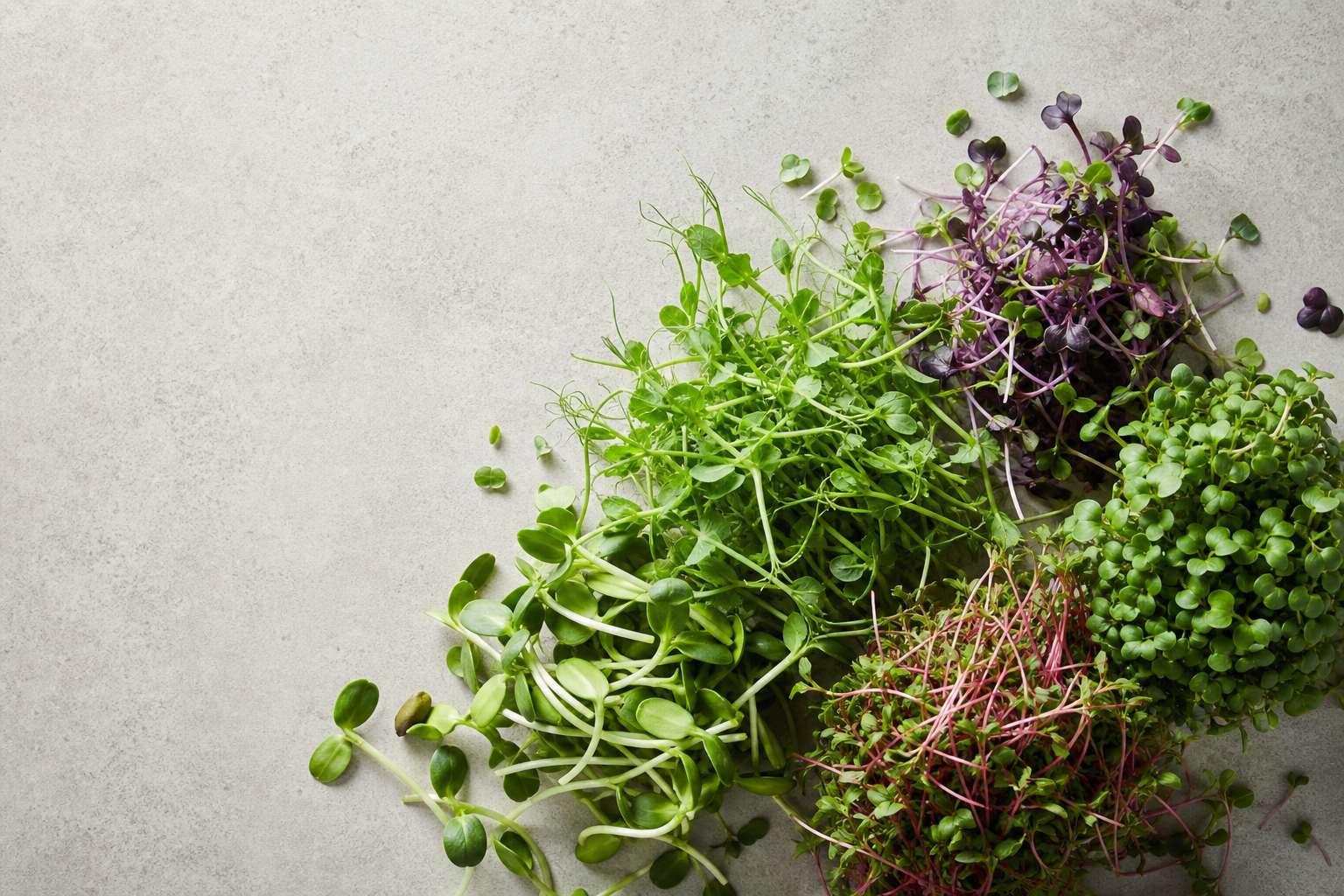
Calories in Microgreens: The Ultimate Low-Calorie Superfood [Expert Analysis]
Answer in brief
Discover exactly how many calories are in every type of microgreen — plus why they deliver up to 40× more nutrients than regular vegetables at the same caloric cost.
Calories in Microgreens: What the Science Actually Says
When people search for "calories in microgreens," they're usually asking one of two questions: "Are microgreens low enough in calories for my diet?" or "Is there a catch — are they actually high in calories?"
The answer to both: microgreens are extraordinarily low in calories. Most varieties range from just 23 to 42 kcal per 100 grams — comparable to lettuce and cucumbers. But unlike those watery vegetables, microgreens deliver a concentrated payload of vitamins, minerals, and bioactive compounds that outperform mature vegetables by enormous margins.
This guide breaks down exactly how many calories you'll find in every popular microgreen variety, explains why the numbers are so low, and shows you how to use this knowledge for smarter, more nutritious eating.
Microgreens Calorie Comparison Table
Here's the definitive calorie reference for 15 microgreen varieties, sorted from lowest to highest caloric content. All measurements are per 100 grams of fresh, raw microgreens.
| Variety | Calories (kcal) | Category |
|---|---|---|
| Spinach | 23 | Ultra-low |
| Red Cabbage | 24 | Ultra-low |
| Amaranth | 26 | Ultra-low |
| Mustard | 27 | Ultra-low |
| Cilantro | 28 | Ultra-low |
| Radish | 29 | Low |
| Arugula | 30 | Low |
| Kale | 31 | Low |
| Broccoli | 32 | Low |
| Buckwheat | 33 | Low |
| Beet | 34 | Moderate |
| Fenugreek | 35 | Moderate |
| Wheatgrass | 36 | Moderate |
| Sunflower | 38 | Moderate |
| Pea Shoots | 42 | Moderate |
Source: USDA FoodData Central (2024)
Bottom line: Every single microgreen variety on this list has fewer calories per 100g than an apple (52 kcal). The entire spectrum, from spinach to pea shoots, falls within a remarkably narrow 23–42 kcal range.
Breaking Down the Calorie Content: What's Inside Those Numbers?
Calories aren't just a number — they come from three macronutrients: protein, carbohydrates, and fat. Understanding the macronutrient makeup of microgreens reveals why they're not just low-calorie, but smartly low-calorie.
Macronutrient Profile (Per 100g)
| Variety | Protein | Carbs | Fat | Dominant Energy Source |
|---|---|---|---|---|
| Pea Shoots | 5.4 g | 7.9 g | 0.5 g | Protein + Complex Carbs |
| Sunflower | 4.1 g | 4.8 g | 1.8 g | Balanced (highest fat) |
| Radish | 3.8 g | 3.7 g | 0.5 g | Protein + Carbs (even split) |
| Broccoli | 3.5 g | 4.1 g | 0.6 g | Carbs + Protein |
| Kale | 3.4 g | 4.4 g | 0.5 g | Carbs (moderate) |
| Fenugreek | 3.3 g | 4.7 g | 0.5 g | Carbs |
| Arugula | 3.2 g | 3.9 g | 0.7 g | Balanced |
| Amaranth | 3.1 g | 3.2 g | 0.4 g | Balanced |
| Mustard | 3.0 g | 3.5 g | 0.4 g | Balanced |
| Buckwheat | 3.0 g | 4.5 g | 0.6 g | Carbs |
| Red Cabbage | 2.9 g | 3.3 g | 0.4 g | Balanced |
| Beet | 2.8 g | 5.2 g | 0.3 g | Carbs (slightly sweet) |
| Wheatgrass | 2.7 g | 6.1 g | 0.6 g | Carbs + Fiber |
| Cilantro | 2.6 g | 3.8 g | 0.5 g | Carbs |
| Spinach | 2.5 g | 3.0 g | 0.4 g | Very low across all |
Key insight: Unlike processed low-calorie foods (rice cakes, diet sodas), microgreens derive their calories from real, functional macronutrients. There are no empty calories here — every calorie comes packaged with vitamins, minerals, fiber, and phytonutrients.
Calories in Microgreens vs. Common Vegetables
One of the most powerful ways to understand microgreen calories is by comparing them to the foods they can replace or supplement in your diet.
Calorie Comparison: Microgreens vs. Mature Vegetables
| Food | Calories/100g | Vitamin C (mg) | Iron (mg) | Key Difference |
|---|---|---|---|---|
| Broccoli microgreens | 32 | 51.3 | 1.1 | 100× more sulforaphane |
| Mature broccoli | 34 | 89.2 | 0.7 | Higher volume per serving |
| Kale microgreens | 31 | 58.0 | 1.4 | 3× more beta-carotene |
| Mature kale | 49 | 120.0 | 1.5 | Higher fiber content |
| Spinach microgreens | 23 | 28.1 | 2.7 | Concentrated iron |
| Mature spinach | 23 | 28.1 | 2.7 | Identical calories, less dense |
| Radish microgreens | 29 | 65.0 | 0.9 | 40× more vitamin C than root |
| Mature radish (root) | 16 | 14.8 | 0.3 | Much lower nutrient density |
The pattern: Microgreens generally match or beat mature vegetables on calories while delivering significantly higher concentrations of vitamins, minerals, and protective plant compounds.
Calorie Comparison: Microgreens vs. Popular "Healthy" Foods
| Food | Calories/100g | Why Microgreens Win |
|---|---|---|
| Quinoa (cooked) | 120 | Microgreens: 4–5× fewer calories with comparable micronutrients |
| Avocado | 160 | Microgreens: 5–7× fewer calories, similar vitamin K levels |
| Almonds | 579 | Microgreens: 14–25× fewer calories per gram |
| Greek yogurt | 59 | Microgreens: ~2× fewer calories, more vitamin C |
| Blueberries | 57 | Microgreens: ~2× fewer calories, higher vitamin density |
| Brown rice (cooked) | 112 | Microgreens: 3–5× fewer calories, vastly more micronutrients |
Perspective check: You could eat 500 grams of mixed microgreens (about 150 kcal) for the same caloric cost as a single tablespoon of olive oil (119 kcal) or 28 grams of almonds (164 kcal).
The "Calorie Efficiency" Concept: Nutrients Per Calorie
Dietitians and nutrition scientists increasingly focus on nutrient density per calorie rather than just total calories. By this measure, microgreens are among the most efficient foods on Earth.
Nutrient Density Score (Nutrients Per 100 Calories)
| Variety | Vitamin C per 100 kcal | Iron per 100 kcal | Protein per 100 kcal |
|---|---|---|---|
| Red Cabbage | 612 mg | 4.2 mg | 12.1 g |
| Radish | 224 mg | 3.1 mg | 13.1 g |
| Broccoli | 160 mg | 3.4 mg | 10.9 g |
| Kale | 187 mg | 4.5 mg | 11.0 g |
| Pea Shoots | 100 mg | 3.8 mg | 12.9 g |
| Sunflower | 178 mg | 2.6 mg | 10.8 g |
What this means in practice: If you consumed just 100 calories worth of red cabbage microgreens (~417g), you'd get 612 mg of vitamin C — nearly 7 times the recommended daily intake. No other whole food comes close to this kind of nutrient-per-calorie efficiency.
Who Benefits Most from the Low Calorie Count?
Weight Management and Calorie-Restricted Diets
For anyone tracking calories — whether for weight loss, maintenance, or body composition — microgreens are a game-changer:
- Volume eating: You can consume large, satisfying portions of microgreens without putting a dent in your daily calorie budget. A 200g microgreen salad is only 46–84 calories.
- Nutrient insurance: Calorie restriction often leads to micronutrient deficiencies. Microgreens solve this by delivering dense nutrition at minimal caloric cost.
- Satiety signals: Foods rich in vitamins and minerals help regulate appetite hormones. Your body craves nutrients, not just calories.
Athletes and Active Individuals
Athletes need maximum nutrition without unnecessary bulk:
- Pre-workout: A light microgreen salad 60–90 minutes before training provides vitamins and minerals without causing digestive heaviness.
- Post-workout recovery: Adding pea shoot microgreens (5.4g protein/100g) to post-workout meals contributes plant-based protein at just 42 calories per 100g.
- Anti-inflammatory support: The sulforaphane in broccoli microgreens and antioxidants in red cabbage microgreens help manage exercise-induced inflammation.
Seniors and Those with Reduced Appetite
Older adults often face the challenge of needing more nutrients with fewer calories due to decreased metabolism and appetite:
- Concentrated nutrition: Even a small 30–50g serving delivers meaningful vitamins and minerals.
- Easy to eat: Microgreens are tender and don't require heavy chewing, making them accessible for those with dental issues.
- Variety without volume: Different microgreen types offer different nutrient profiles, allowing dietary diversity without large portions.
Practical Ways to Add Low-Calorie Microgreens to Your Diet
Breakfast (Add 5–15 calories)
- Scatter a handful of radish or arugula microgreens over scrambled eggs
- Blend spinach or pea shoot microgreens into your morning smoothie
- Top avocado toast with a generous layer of broccoli microgreens
Lunch (Add 10–25 calories)
- Use sunflower microgreens as the base for a nutrient-dense salad instead of iceberg lettuce
- Roll microgreens into wraps and sandwiches as a crunchy, nutritious layer
- Stir kale or mustard microgreens into grain bowls just before serving
Dinner (Add 5–20 calories)
- Garnish soups and stews with fresh microgreens after plating
- Mix cilantro or radish microgreens into tacos, curries, and stir-fries
- Use as a bed under grilled fish or chicken for added nutrients and visual appeal
Snacks (Add 3–10 calories)
- Top hummus or guacamole with a small pile of microgreens
- Add to smoothies for a nutrient boost without changing the flavor profile significantly
- Pair with a handful of nuts for a balanced mini-meal
Frequently Asked Questions (FAQ)
Are there zero-calorie microgreens?
No food has truly zero calories. However, spinach microgreens at 23 kcal/100g and red cabbage microgreens at 24 kcal/100g are close to "negligible calorie" territory. A typical 25g serving of these contains only 5–6 calories — less than a single cherry tomato.
Do cooking or processing microgreens change the calorie count?
Minimally. Cooking microgreens doesn't add or significantly reduce calories — the macronutrients remain the same. However, cooking can reduce water-soluble vitamins (especially vitamin C). For maximum nutrition and minimum calories, eat microgreens raw or add them to hot dishes at the last moment.
Are microgreens more calorie-dense than sprouts?
They're similar. Most sprouts contain 20–35 kcal/100g, overlapping heavily with the microgreen range. The key difference is nutritional: microgreens have undergone photosynthesis (they grew in light), which dramatically increases their vitamin, mineral, and antioxidant content compared to sprouts grown in the dark.
How many microgreens can I eat in a day?
There's no established upper limit for microgreen consumption. From a calorie perspective, eating 200–300g per day (about 50–125 calories) is easily achievable and provides substantial nutritional benefits. Some enthusiasts consume 400–500g daily. The only practical limits are cost and availability.
Do different growing methods affect calorie content?
Growing conditions (soil vs. hydroponic, natural vs. artificial light) can slightly affect nutrient profiles but have negligible impact on calorie content. The macronutrient composition of microgreens is primarily determined by genetics (the seed variety) and harvest timing, not growing medium or light source.
Which microgreen has the best calorie-to-protein ratio?
Pea shoots lead with 5.4g of protein per 42 calories (12.9g protein per 100 kcal), followed by radish at 3.8g per 29 calories (13.1g per 100 kcal). If you're optimizing for maximum protein with minimum calories, these two varieties are your best options.
Source & Data Reliability
All calorie and macronutrient data presented in this article are derived from:
- USDA FoodData Central — The United States Department of Agriculture's comprehensive food composition database
- Journal of Agricultural and Food Chemistry — Peer-reviewed studies on microgreen nutrient composition
- Xiao et al. (2012) — Assessment of vitamin and carotenoid concentrations of emerging food products: edible microgreens
Individual values may vary slightly based on growing conditions, harvest timing, and variety-specific genetics. The figures presented represent laboratory-analyzed averages from multiple studies and should be used as reliable reference points for dietary planning.
Conclusion
The calories in microgreens tell a remarkable story: 23 to 42 kcal per 100 grams — barely a blip in anyone's daily caloric budget, yet packed with nutrient concentrations that rival or exceed those of mature vegetables, nuts, and even some supplements.
Whether you're managing weight, fueling athletic performance, or simply seeking the most nutritionally efficient foods available, microgreens deserve a permanent spot in your diet. They prove that the most nutrient-dense foods don't have to be the most calorie-dense — and that's a powerful insight for anyone who takes their health seriously.
Start small — a 30g handful on your next meal — and experience the difference that low-calorie, high-nutrient eating can make.
Nutritional data sourced from USDA FoodData Central and peer-reviewed studies published in the Journal of Agricultural and Food Chemistry.