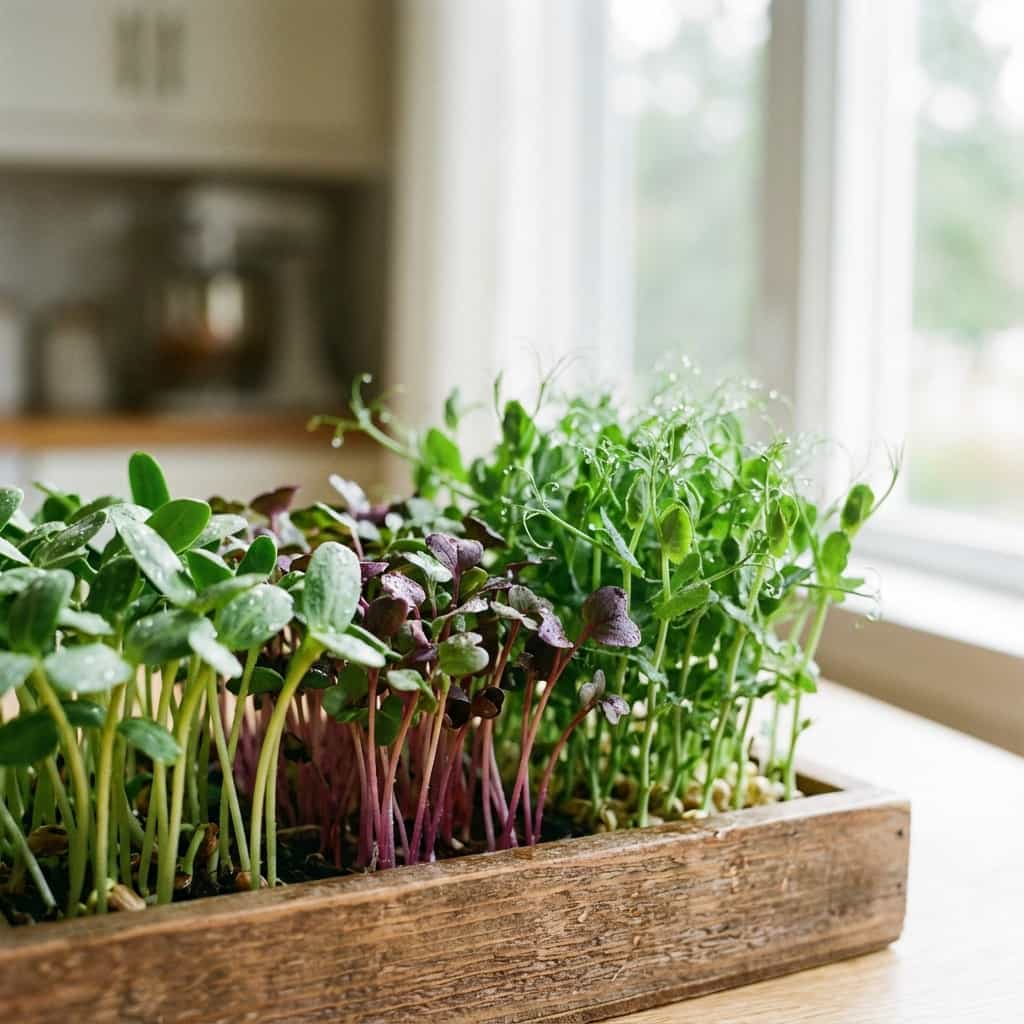
Why Microgreens Work So Well With Kids
Most children's gardening projects fight against short attention spans. Tomatoes take three months. Sunflowers take two. The gap between planting and reward is long enough for a child's enthusiasm to completely dissipate.
Microgreens work because the feedback loop is short. Seeds sprout overnight. Tiny green shoots appear in two or three days. Harvest happens within a week to ten days. A child who plants seeds on Monday can eat what they grew by the following weekend.
That speed is the first hook. But the bigger payoff is one that parents consistently report: children eat food they grew themselves. The same arugula that gets pushed around a plate mysteriously becomes acceptable — sometimes eagerly eaten — when a seven-year-old cut it with their own scissors.
Choosing the Right Varieties for Kids
Not all microgreens are equally suitable for a first grow with children. Choose varieties that:
- Germinate quickly and visibly
- Have dramatic appearance changes kids can track
- Taste mild enough for children's palates
Best Starting Varieties
Sunflower — The crowd favorite for kids. Seeds are large enough for small hands to handle, the sprouts are thick and satisfying, and the flavor is mild, slightly nutty, and generally liked even by picky eaters. The hulls that pop off during growth add entertainment value.
Pea Shoots — Sweet, tender, and genuinely tasty to most children. Pea seeds are easy to handle, germinate reliably, and the plants produce curling tendrils that are visually delightful. Kids often snack on pea shoots directly from the tray.
Radish — Faster than almost anything else (6–8 days). The vivid contrast of green leaves and hot-pink or red stems is visually striking. The flavor is peppery — some children love it, others don't — so introduce it as a topping rather than a standalone snack.
Broccoli — Reliable and fast. The taste is very mild (milder than mature broccoli). A good choice if your goal includes getting children to try broccoli by stealth.
Wheat Grass — Dramatic visual growth with grass-like blades. Most children won't eat wheatgrass directly, but growing it is a great demonstration of germination and growth. Use it as a science experiment alongside an edible variety.
The Right Approach by Age
Ages 4–6: The Wonder Years
At this age, the process matters more than the outcome. Focus on:
- Letting small hands pour seeds into a tray (sunflower or pea seeds, easy to handle)
- Watching germination together — lift the cover each morning as a ritual
- Simple vocabulary: seeds → roots → sprouts → leaves → food
- Taking photos at each stage for a simple "growth diary"
Keep tasks short (5 minutes), participate alongside them, and narrate what's happening. "Look, can you see the white root growing down? That's how it finds water." This is enough. Don't push for eating results — if they're curious and taste it, great.
Ages 7–10: The Builders
Children in this range can handle more responsibility and enjoy ownership:
- Let them choose the variety from a short list you approve
- Give them a dedicated tray that is their project
- Teach them to check moisture and water (with supervision on amount)
- Introduce the harvest step — using scissors properly is a satisfying skill milestone
- Chart growth: measure stem height with a ruler and record in a notebook
The chart technique is surprisingly powerful. Seeing numbers grow ("it grew 2 cm since yesterday!") engages a different kind of motivation than just observing.
Ages 11–14: The Scientists
Older children can treat microgreens as a genuine project with variables:
- Compare two varieties grown at the same time — which is faster? Which tastes different?
- Test variables: same variety, different watering frequency or light exposure
- Read the nutrition evidence together and ask why results vary by crop and study
- Calculate costs and yields — a simple spreadsheet teaches real-world math
- Research and choose their own varieties beyond your starter list
This age group often gravitates toward the production tracking mindset: planning batches, succession growing, and improving systems.
Setting Up a Kid-Friendly Grow Station
Location: A low shelf, kitchen counter, or small table at child height is ideal. Bending over to check a grow at adult height is a barrier; eye-level access invites daily inspection.
Equipment for small hands:
- Small, lightweight watering can with a fine rose head (heavy watering cans lead to flooding)
- Child-sized scissors for harvest (standard craft scissors work)
- A spray bottle for gentle misting
- A simple chart or journal for tracking
Containing the mess: Growing medium inevitably ends up outside the tray. A plastic tray with a lip placed underneath the grow tray catches most of it. An old shower curtain or plastic sheet under the station is also effective for the watering stage.
Making the Growing Ritual Stick
The biggest challenge isn't teaching children to start a grow — it's maintaining the daily check-in habit over 8–10 days. Build the routine around an existing anchor:
- Morning breakfast table → "Let's check the tray before eating"
- After school → "First thing, let's look at the seeds"
- Bedtime → A final check before stories (seeds germinate overnight; this creates anticipation)
Photography as engagement: A child who takes a phone photo of their tray every day and watches the time-lapse grow is far more engaged than one who just glances at it. A simple phone holder positioned above the tray makes this easy.
From Tray to Table: Cooking With Kids
The bridge from growing to eating is where the behavioral shift happens. Don't just cut the microgreens and add them to adult food — involve children in the preparation.
Simple kid-friendly microgreen recipes:
- Pea shoot and egg on toast — Scramble an egg, pile pea shoots on top of toast, add a drizzle of olive oil. Fast, nutritious, child-friendly.
- Radish microgreen quesadilla — Cheese quesadilla with radish microgreens added after cooking for crunch and color.
- Microgreen and butter pasta — Simple pasta tossed with butter and a handful of fresh microgreens stirred in just before serving.
- Sunflower microgreen dip — Blend sunflower microgreens with cream cheese, lemon, and a pinch of salt. Serve with crackers.
- The build-your-own plate — Put out bowl of microgreens, crackers, and various toppings. Let children construct their own combinations.
The "build your own" approach works especially well because it gives children control over what they eat — a key factor in reducing food resistance.
What to Do When It Goes Wrong
Microgreens are forgiving, but a few things can dampen a child's enthusiasm:
Mold appears: Frame it as a science observation, not a failure. "Look at the mold — those are tiny fungi. They grew because there was too much water and not enough air. What should we do differently next time?" Then sanitize and start fresh.
Nothing sprouted: Old or damaged seeds are the most common cause. Buy fresh seeds and try again. Consider it a lesson in why seed quality matters.
Child loses interest mid-grow: Don't force it. Do the watering yourself and invite them to harvest when it's ready. The harvest is usually enough to re-engage a child who drifted away mid-cycle.
The Bigger Picture
Beyond the practical reasons, growing food with children builds something that's harder to put a metric on: a relationship with where food comes from. A child who has watched a seed become a plant they ate understands in a visceral, embodied way that food is made, not just bought.
That understanding, once established, tends to stick. It shapes food curiosity, reduces food waste, and plants the seed — so to speak — of a lifelong connection to growing things.
Start small. One tray, one variety, one weekend. The results tend to take care of the rest.