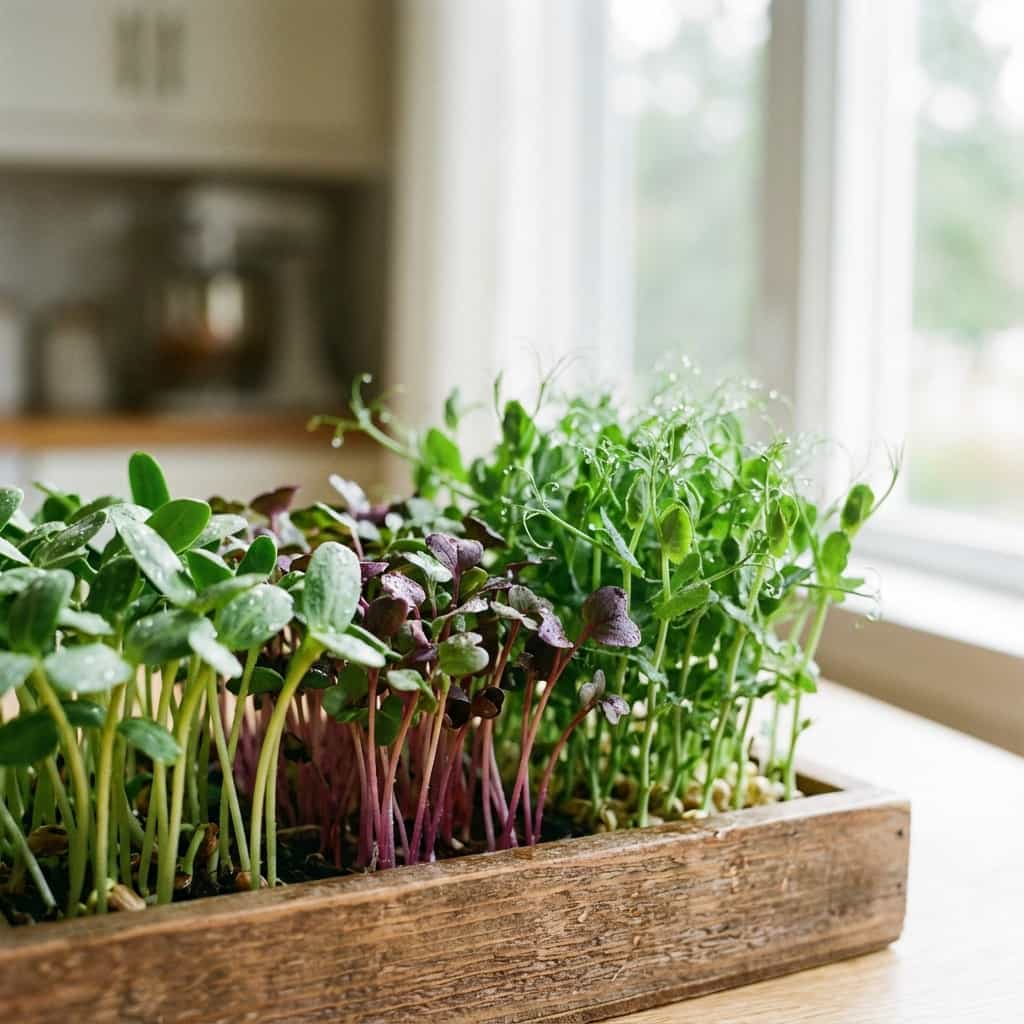
Why the Container Matters
Most beginners fixate on seeds and growing medium, but the container shapes almost every variable in a microgreen grow: how evenly moisture distributes, how well roots anchor, whether the crop tilts or stands upright, and how efficiently you can harvest.
The wrong tray doesn't ruin your crop — but the right one makes consistent results much easier to achieve.
The Standard: 1020 Trays
The industry benchmark is the 1020 flat — a 10 × 20 inch (25 × 51 cm) tray originally designed for commercial greenhouse production. It's the most common choice for microgreens growers at every scale, and for good reason:
- Fits standard shelving systems and grow racks designed around this footprint
- Available in depths from 1 inch (shallow) to 2.5 inches (deep)
- Sold with or without drainage holes
- Stackable for the blackout/weighting phase
- Widely compatible with humidity domes
Solid vs. Perforated: Buy both. Use the solid (no-hole) tray as the base for bottom-watering; place the perforated tray with your growing medium inside it. This system keeps roots from sitting in standing water while allowing you to water from below — the superior method for mold prevention.
Choosing Tray Depth
Tray depth is more important than most guides acknowledge:
| Depth | Best For |
|---|---|
| 1 inch (2.5 cm) | Shallow-root crops: radish, broccoli, arugula, kale |
| 1.5 inch (3.8 cm) | General purpose — works for almost everything |
| 2–2.5 inch (5–6 cm) | Sunflower, pea shoots, wheatgrass; anything with aggressive root systems |
Shallower trays use less growing medium, dry out faster, and are lighter to handle. Deeper trays hold more medium and stay moist longer — ideal for thick-seeded crops like sunflower and pea that need more anchor support.
Material Comparison
Plastic (Polypropylene / HDPE)
The default for most growers. Lightweight, stackable, affordable, and easy to sanitize with hydrogen peroxide or diluted bleach. Look for BPA-free or food-grade labeling if you're concerned about leaching, though the risk at room temperature is minimal.
Durability: Standard nursery trays last 3–5 grows before cracking at the corners. Thicker commercial-grade plastic can last 30+ cycles with proper care.
Avoid: Flimsy single-use seedling trays. They warp, bow under the weight of moist medium, and crack after 1–2 uses.
Stainless Steel
A step up for serious growers. Won't leach chemicals, resists staining, and can be sanitized at high temperatures. Expensive upfront but lasts indefinitely. The main downside is heat absorption — don't place directly in strong sunlight or near heat sources.
Ceramic and Clay
Not practical for microgreens. Too heavy, difficult to stack, and not compatible with standard grow rack dimensions. Avoid.
Bamboo and Wood
Aesthetically appealing for home use. Practical limitations include absorption of moisture (which can harbor bacteria) and difficulty sanitizing. If you use wood, line with a food-safe liner and replace it each grow cycle.
Alternatives for Home Growers
You don't need 1020 trays to grow excellent microgreens at home. Common household containers work well when set up correctly:
- Baking dishes (glass or ceramic) — Good depth, easy to clean, often available at home
- Plastic food storage containers — Drill or poke drainage holes in the bottom; nest inside a second container for bottom watering
- Take-out containers — Work for single-portion grows; not ideal for scale
- Window boxes — Good for longer varieties like pea shoots and sunflower on a windowsill
The core requirement for any container is simple: it must hold at least 1–1.5 inches of growing medium and allow for some form of drainage management.
Drainage Holes: Yes or No
The conventional advice is to always use drainage holes. This is correct for most situations. However, there's a nuance worth understanding:
Bottom-watering setup requires a solid tray as the reservoir and a perforated tray sitting inside it. Water is absorbed upward through the holes.
Top-watering works fine with a perforated tray and a simple catch tray underneath, but creates more humidity at the stem base — increase airflow to compensate.
No-hole containers can work if you're extremely careful with water volume. The risk of overwatering (and thus mold) is significantly higher. Not recommended until you have a reliable sense of how much water your medium holds.
Cover and Dome Options
During germination and the blackout phase, covering your tray increases humidity, accelerates sprouting, and provides the gentle pressure that encourages downward rooting.
Options from simplest to most refined:
- A second tray flipped upside down — Free, works well, the standard approach
- A second tray + weight on top — Add a full water bottle or a brick for crops that need more pressure (sunflower, pea)
- Humidity dome — A clear plastic dome with adjustable vents; better humidity control but adds cost
- Blackout cloth — Drape over trays on shelves; useful when you have multiple trays stacked in rows
The weighting technique is often underutilized. Pressing down on germinating seeds encourages them to push the seed hull off and anchor more firmly, resulting in sturdier, more uniform seedlings.
Cleaning and Reuse
Reusing trays is economical and reduces waste, but only if they're properly sanitized between grows. Any residue of roots, organic material, or moisture can harbor pathogens.
Between each grow:
- Remove all growing medium and roots — don't compost roots from potentially moldy trays
- Scrub with dish soap and warm water
- Rinse thoroughly
- Soak for 10–30 minutes in a 3% hydrogen peroxide solution or 1 part bleach to 9 parts water
- Rinse again and allow to air dry completely before storing or reusing
Trays with visible cracks or deep scratches are harder to sanitize and should be replaced.
The Setup That Works
For consistent results, the simplest effective setup is:
- 1020 perforated tray filled with 1–1.5 inches of growing medium
- 1020 solid tray underneath as the water reservoir
- A second solid tray + weight for the blackout phase
- Humidity dome or blackout cloth optional but useful for difficult varieties
Once you have this base setup, everything else — the variety, the growing medium, the watering schedule — becomes much easier to control.