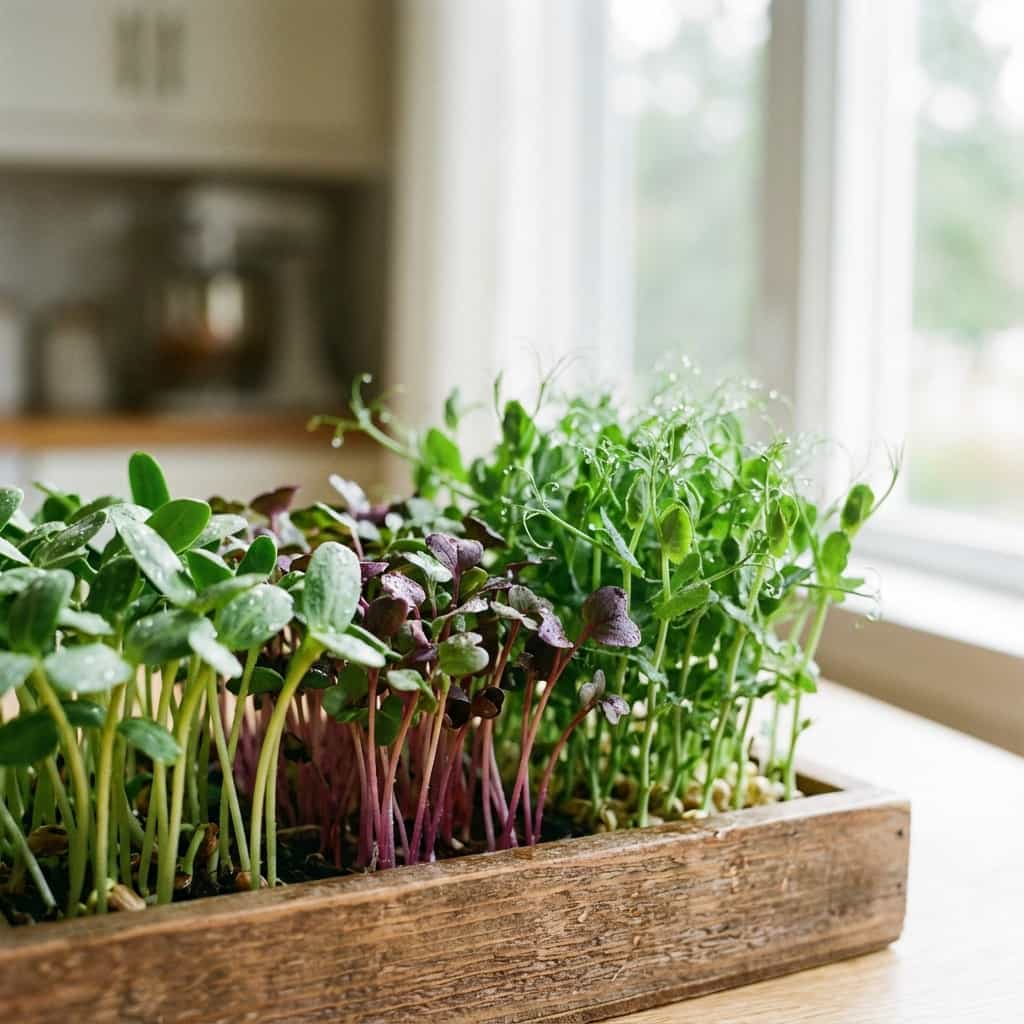
Is Selling Microgreens Actually Viable?
The short answer: yes, for the right grower in the right market. But the path from "I grow beautiful sunflower shoots at home" to "I run a profitable microgreens business" involves a set of decisions that catch many aspiring sellers unprepared.
This guide doesn't romanticize the opportunity or dismiss it. It maps the actual decisions you'll face and what each involves.
Understanding the Economics
Microgreens generate among the highest revenue per square foot of any crop — a widely cited figure is $20–50 per square foot per year, depending on variety and market. But revenue per square foot is a ceiling metric, not a business plan.
The costs that erode margins:
- Seeds: Premium varieties (sunflower, pea, basil) cost significantly more per gram than commodity crops. Seed cost typically runs 20–35% of revenue for small operations.
- Growing medium: Coco coir and hydroponic mats at volume are cheaper per unit, but the investment in substrate adds up.
- Packaging: Food-safe clamshells or bags suitable for retail and farmers' market presentation cost €0.15–0.40 per unit — a significant cost per tray.
- Labor: At small scale, the labor cost is your time. Measure it. Most growers don't until they're six months in.
- Energy: Lighting (if you use grow lights), heating in winter, and any refrigeration all carry ongoing costs.
A realistic gross margin for a home-scale operation selling to restaurants or farmers' markets is 40–60% before accounting for your own labor. Net margin after labor is often much thinner — which is why most successful microgreen businesses either scale significantly or treat the income as a supplement, not a primary income stream.
Choosing Your Market Channel
The channel you choose shapes everything — pricing, volume, packaging, and how much of your week goes to selling versus growing.
Restaurants and Cafés
High unit prices, consistent volume if you retain the client, and no retail packaging needed. The downsides: a single restaurant client canceling is a significant revenue loss, chefs are demanding about consistency and freshness, and you'll often be expected to deliver on their schedule.
What chefs actually want: Consistent quality week to week (more important than exceptional quality that varies), reliable delivery windows, and usually 3–5 variety options they can count on. Rare or unusual varieties are a nice-to-have, not a priority.
Farmers' Markets
Direct-to-consumer pricing (typically 2–3x what you'd charge a wholesale restaurant account), face-to-face relationship building, and real-time feedback on which varieties sell. The tradeoff: market fees, time away from production, weather variability, and the need for attractive presentation materials.
What sells at markets: Radish (visual impact), pea shoots (familiar name), and sunflower (recognizable). Novel varieties like amaranth or mustard take education and time to move.
Online and CSA (Community Supported Agriculture)
Subscription models provide predictable revenue. You sell a weekly share of whatever you're growing — customers pay upfront for the season. This reduces selling time but requires a pre-existing customer base or significant marketing effort to build one.
Local Grocery and Specialty Food Stores
Requires consistent volume, appropriate packaging, and often a minimum shelf life guarantee. Local independents are more accessible than chains; chains involve distribution infrastructure most small growers can't support initially.
Regulatory Considerations
Food safety regulation for microgreens varies significantly by country and region. What's required in one municipality may differ from the next.
Common requirements you should research locally:
- Cottage food laws: Some jurisdictions allow direct-to-consumer food sales from home kitchens below a revenue threshold; others don't cover produce.
- Commercial kitchen requirements: Selling to restaurants or retail often requires production in a licensed commercial kitchen — your home kitchen typically won't qualify.
- Water source certification: Some regions require testing of water used in food production.
- Labeling requirements: Packaged produce sold at retail usually requires ingredient labeling, allergen information, and often a contact address.
The practical step: contact your local food safety authority before spending significantly on infrastructure. A 30-minute consultation can save months of expensive mistakes.
The Varieties That Work Commercially
Not every variety that's beautiful at home performs well commercially. Commercial viability depends on:
- Seed cost vs. selling price ratio — expensive seeds (basil, cilantro) need premium pricing or high volume
- Days to harvest — faster-growing varieties (radish: 6–8 days) enable more cycles per year
- Yield consistency — varieties that produce predictable, uniform trays are easier to sell
- Market familiarity — buyers pay more readily for things they recognize
The commercially reliable core: radish, broccoli, sunflower, pea shoots, and kale. These form the production backbone of most successful small operations. Differentiation comes from quality, consistency, and relationship — not exotic variety lists.
What Scaling Actually Requires
Home growers often think scaling means more trays. It does — but it also means:
- Dedicated growing space — separate from living areas; temperature and humidity control becomes non-negotiable
- Systematic processes — sowing, watering, and harvesting on fixed schedules; inconsistent process creates inconsistent product
- Refrigeration capacity — harvested product needs storage below 5°C; a dedicated fridge for production is different from your kitchen fridge
- Record keeping — batch tracking, yield records, cost per tray; you can't improve what you don't measure
- Time allocation — growing, harvesting, delivering, selling, and administration; most growers underestimate the non-growing time
The growers who build sustainable businesses tend to share one trait: they systematize before they scale, not after.
An Honest Assessment
Microgreens are a genuinely viable small business opportunity in the right conditions: urban or suburban markets with restaurant density, active farmers' market scenes, or strong community food culture. They're not a get-rich-quick proposition and they're not passive income.
The most common failure mode is scaling production before securing reliable buyers. Grow your customer base first, then expand capacity to match demand. Starting with 10–20 trays, landing two or three reliable buyers, and understanding your actual cost structure takes 3–6 months. That foundation makes scaling a planned process rather than a gamble.