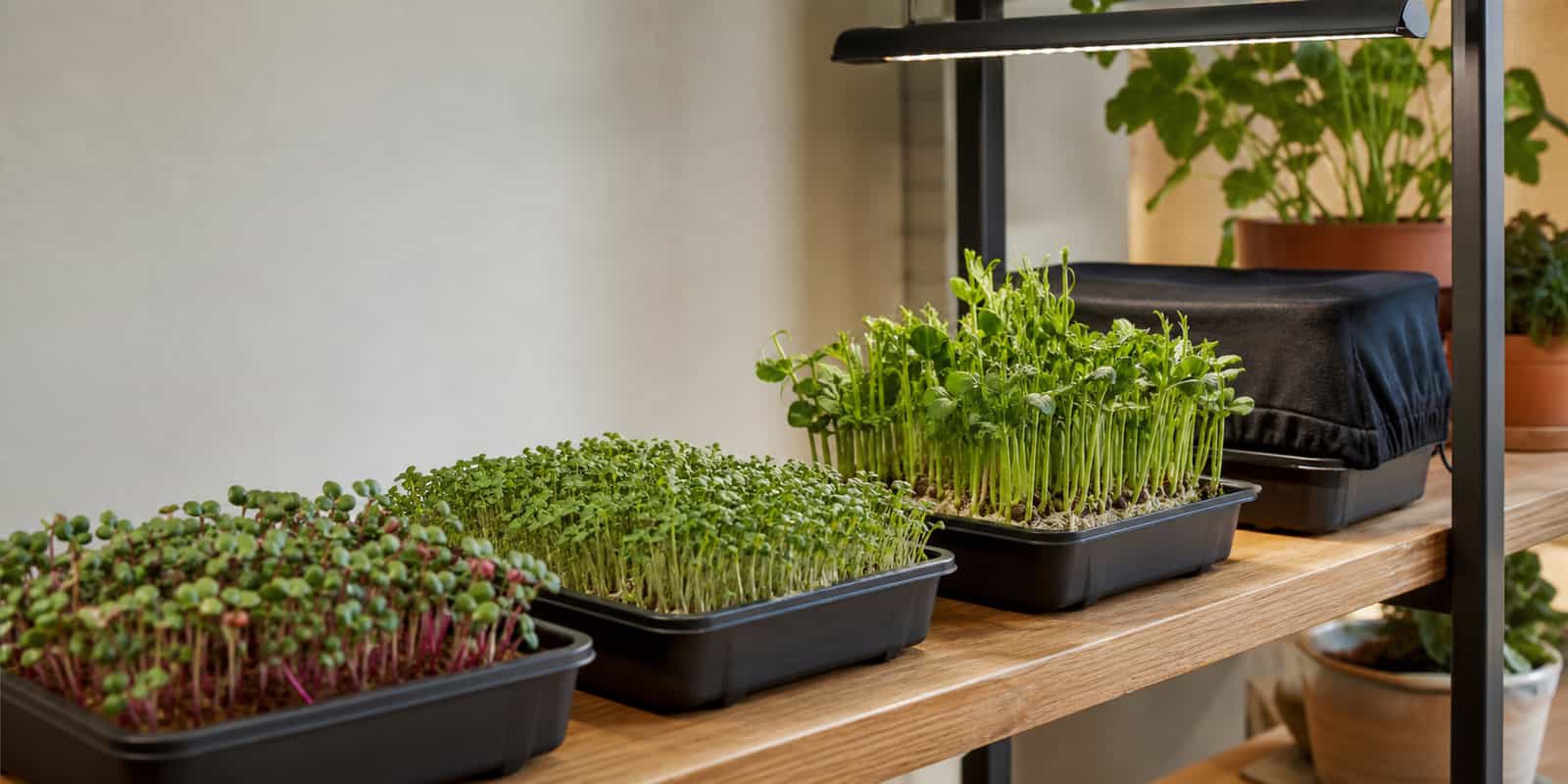
Why Winter Changes Everything
Microgreens are grown indoors year-round, which lures growers into thinking the season doesn't matter. It does — especially once you've experienced your first winter stall.
The challenges multiply: ambient room temperature drops into ranges that slow germination, central heating systems drop relative humidity to 20–30% (desert-level dryness), natural light shortens and weakens, and cold window sills can chill tray bottoms below optimal root temperature. None of these individually collapse a grow, but together they push yields down, extend timelines, and make mold cycles less predictable.
The good news: microgreens are among the easiest crops to grow indoors regardless of season, and a few targeted adjustments produce consistent results even in January.
Temperature: The Core Variable
The optimal germination temperature for most microgreens is 20–24°C (68–75°F). Below 18°C, germination slows significantly. Below 15°C, some varieties stall or fail entirely.
What Actually Drops in Winter
The ambient room temperature your thermostat reads doesn't tell the whole story. What matters for your microgreens is the temperature at tray level — specifically the medium surface and the zone just above it.
Cold spots to watch:
- Window sills — Glass conducts cold, and sills sitting directly over or under windows can drop 3–5°C below room temperature
- Floor-level shelving — Cold air sinks and pools near floors in poorly insulated homes
- Concrete surfaces — Basements or garages with concrete floors stay cold regardless of air temperature
Practical Fixes
- Move trays away from cold windows — Use grow lights instead of relying on natural light from cold glass
- Elevate trays off cold surfaces — A wooden board or shelf insert between the tray and a cold surface makes a measurable difference
- Use a seedling heat mat — The most effective single upgrade for winter germination. These mats maintain the medium at 21–27°C regardless of ambient temperature. Choose a mat with a thermostat for precise control.
- Cluster your trays — Multiple trays close together retain more heat than isolated trays
Temperature by Phase
| Phase | Optimal Range | Winter Adjustment |
|---|---|---|
| Germination (blackout) | 20–24°C | Use heat mat |
| Light phase | 18–22°C | Move to warmest room area |
| Near-harvest | 16–20°C | Normal — slight coolness extends shelf life |
Humidity: The Hidden Winter Enemy
Central heating is the enemy of microgreen growers in cold climates. Forced air heating systems routinely push indoor relative humidity below 30%. For microgreens, this creates two simultaneous problems:
- Accelerated drying — The growing medium loses moisture faster, demanding more frequent watering and increasing the risk of a moisture miscalculation
- Leaf stress — Cotyledons and early true leaves curl, yellow at the edges, or develop a leathery texture in very dry air
Target range: 50–70% relative humidity for the growing area.
Raising Humidity Without Complications
- Humidity dome or cover — Keeping a cover on your trays for longer during the light phase (not just blackout) helps maintain moisture locally
- Small room humidifier nearby — A ultrasonic humidifier near your grow area is the most reliable fix. Keep it at least 50 cm from trays to avoid direct mist on leaves
- Cluster plants — Multiple plants and trays together create a microclimate with slightly higher humidity
- Shallow water tray nearby — A dish of water near (not under) your grow area evaporates slowly into the air
Avoid: Misting leaves directly in winter. Evaporation is slower in humid indoor air and excess leaf moisture is the primary trigger for mold when ventilation is reduced.
Lighting in Winter
In northern latitudes, winter daylight hours can drop below 9 hours and light intensity through glass is a fraction of summer levels. If you've been growing on a sunny south-facing window sill in summer, expect significant timeline extensions and leggy seedlings in December.
Supplementing or Replacing Natural Light
Grow lights become essential, not optional, for winter reliability.
For microgreens, you don't need complex lighting setups:
- Full-spectrum LED panels — Most efficient and effective option; look for panels with a color rendering index (CRI) above 90 and output around 200–400 µmol/m²/s PPFD
- T5 fluorescent tubes — Older technology but still effective for microgreens, which require less light intensity than fruiting plants
- LED grow bars or strips — Good for shelf-mounted systems; easier to position close to trays
Winter Light Schedule
Microgreens don't require a specific photoperiod (day/night cycle) the way flowering plants do — they respond primarily to total light received. A 16-hour light / 8-hour dark cycle works well in winter and doesn't interfere with their non-photoperiod-sensitive growth.
Light distance: Keep your grow light 15–30 cm (6–12 inches) above tray tops. Closer increases intensity but also heat; farther reduces intensity and promotes legginess.
Managing the Transition From Blackout to Light
In summer, moving trays to a window is a gradual natural transition. In winter, if you're moving from a heat mat in a dark cupboard to a room with natural light, the temperature drop can be jarring.
Aim to keep the temperature change between phases below 4°C. If your growing space is significantly cooler than your germination area, extend the blackout phase by a day and allow the transition to happen at the warmest time of day.
Which Varieties Perform Best in Winter
Cold-tolerant, fast-germinating varieties handle winter conditions with minimal intervention:
Reliable in winter:
- Radish — Fast, cold-tolerant, germinates well as low as 15°C
- Broccoli — Consistent performer, handles temperature variation well
- Kale — Cold-hardy, dense germination, forgiving of humidity swings
- Pea shoots — Prefer slightly cooler temperatures (16–20°C), making them ideal for cool rooms
- Mustard — Germinates aggressively even in suboptimal conditions
Requires more attention in winter:
- Basil — Highly cold-sensitive; needs stable heat above 22°C, humidity above 55%, and bright light. Consider skipping basil until spring unless you have a heat-controlled setup.
- Amaranth — Slow in cool conditions; extend timeline by 2–3 days
- Cilantro — Notoriously uneven germination is worsened by cold; pre-soak seeds for 8–12 hours and maintain warmth during germination
Extended Timelines: Planning Ahead
Cold conditions extend timelines. What normally takes 8 days may take 10–12 in a poorly heated space. Plan your succession growing schedule accordingly — add 1–2 days to your usual intervals between batches in winter.
A practical approach: track actual vs. expected harvest dates over 2–3 winter grows, then use your observed data to set your batch intervals. Grow journals pay off most in the seasons with the most variability.
The One-Hour Warm-Up Rule
If you're moving freshly seeded trays from a cold space (like a garage or spare bedroom) into your main growing area, allow trays to acclimatize at room temperature for 30–60 minutes before covering or placing on a heat mat. Sudden temperature changes can cause condensation inside covered trays — the fastest path to mold in cold weather.
Summary: The Winter Checklist
- Measure actual tray-level temperature (not just room thermostat)
- Use a seedling heat mat for germination if room is below 20°C
- Check relative humidity — supplement with humidifier if below 40%
- Switch to grow lights if natural light is below 9 hours or quality is poor
- Choose cold-tolerant varieties: radish, broccoli, kale, pea, mustard
- Add 1–2 extra days to your expected timeline
- Allow trays to acclimatize before sudden temperature transitions