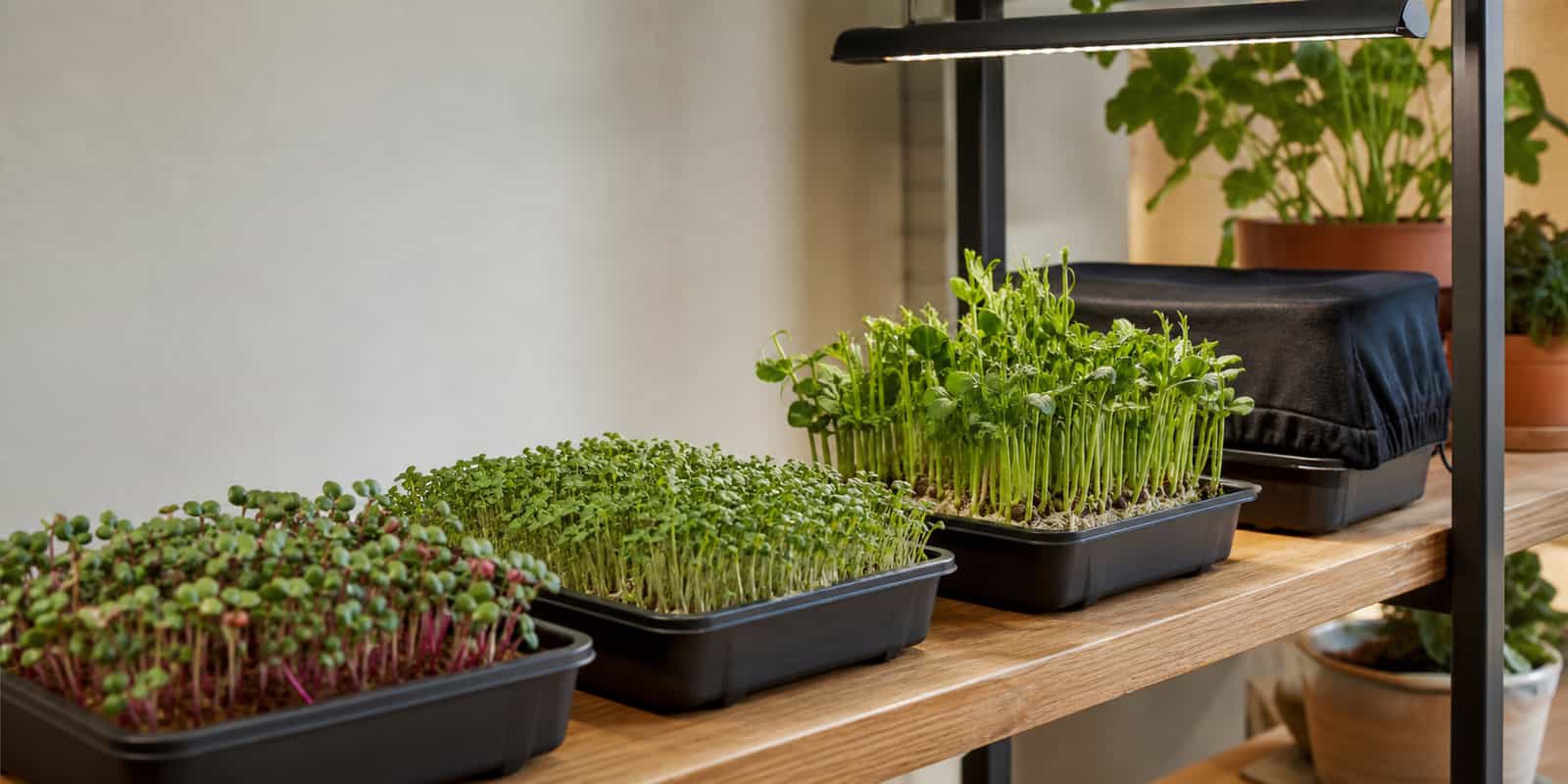
Should you soak microgreen seeds?
Most microgreen seeds do not need soaking. Penn State Extension recommends an 8–12 hour presoak only for some larger or hard-coated seeds, while Utah State University’s crop table lists pea at 6 hours and sunflower at 12 hours. Arugula, basil, broccoli, cilantro, kale, radish, and rutabaga are listed as no presoak.
Soaking every seed can increase excess moisture and make small or mucilaginous seeds harder to spread.
Quick soaking chart
| Crop | Presoak | Practical note |
|---|---|---|
| Pea | About 6 hours | Drain thoroughly before sowing |
| Sunflower | About 10–12 hours | Rinse, drain, then sow on moist medium |
| Arugula | No | Sow dry on pre-moistened medium |
| Basil | No | Mucilage forms around wet seed; sow dry |
| Broccoli | No | Keep the medium evenly moist after sowing |
| Cilantro | No in the cited USU method | Follow the seed supplier if a split-seed method is specified |
| Kale | No | Sow dry |
| Radish | No | Sow dry |
These are starting points, not guarantees for every seed lot. Follow the supplier’s crop-specific directions when they differ.
Safe soaking method for pea and sunflower
- Use seeds sold for food or microgreen production.
- Use a clean food-grade container and drinking-quality water.
- Soak only for the crop’s recommended window.
- Rinse once or twice during a longer soak so the seed receives fresh water and oxygen.
- Drain completely in a clean colander.
- Sow immediately onto pre-moistened medium.
- Avoid standing water and provide drainage.
Water used for soaking, rinsing, irrigation, and postharvest washing should be free of E. coli, according to Penn State’s microgreen food-safety guidance.
Signs that soaking went wrong
- sour or fermented odor;
- slimy seed surface;
- cracked, waterlogged seed;
- standing water after sowing;
- uneven clumps that cannot be spread;
- rapid mold-like growth before roots establish.
Discard a batch with an abnormal odor or obvious spoilage. Do not try to rescue questionable seed for food production.
If germination is poor
Soaking is only one variable. Also check seed age and germination rate, temperature, seed density, moisture, tray drainage, blackout method, and whether the seed was intended for microgreen production.
Continue with the germination troubleshooting guide, mold prevention guide, growing-medium guide, equipment guide, and 23 crop guides. When the crop is ready, use it in one of the 17 harvest recipes.
Sources
- Penn State Extension, A Step-By-Step Guide for Growing Microgreens at Home.
- Utah State University Extension, Grow Your Own Microgreens.
- Penn State Extension, Ensuring Food Safety in Microgreens Production.
Last reviewed: 23 August 2026.