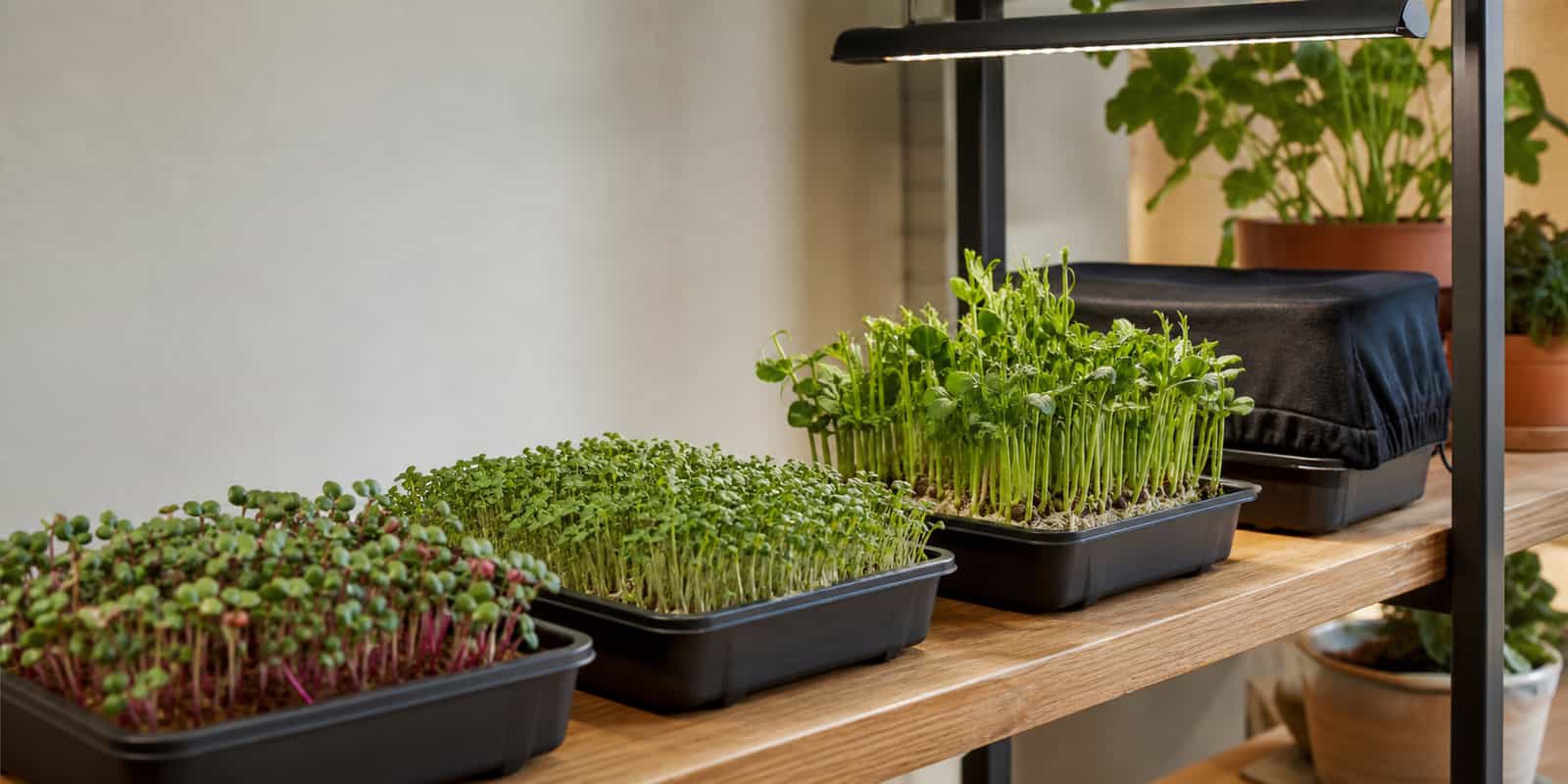
What Germination Actually Is
Germination is not just a seed "waking up." It's a precisely orchestrated sequence of biochemical events that transforms a dormant embryo into a living seedling — and every stage matters for microgreen growers.
When a seed absorbs water (a process called imbibition), it triggers enzyme production. Those enzymes break down stored starches and proteins inside the seed into simple sugars and amino acids — fuel for the emerging root tip. The radicle (embryonic root) breaks through the seed coat first, anchoring the plant. Then the shoot pushes upward. In microgreens, this entire cycle from planting to visible sprout typically takes 24–72 hours depending on the variety.
Understanding this biology gives you leverage: germination rate, germination speed, and seedling uniformity are all directly manageable variables.
The Four Conditions Seeds Need
1. Moisture
Water is the ignition switch. Seeds need consistent moisture — not flooding, not drying out. The growing medium should feel like a wrung-out sponge throughout germination. Even a brief dry period can halt germination mid-process, killing the emerging radicle.
Target moisture level: Squeeze a handful of your growing medium. It should form a shape without dripping. If water runs out, it's too wet.
2. Temperature
Enzymatic activity is temperature-dependent. Too cold, and the process slows or stops. Too hot, and the enzymes denature (break down). Most microgreen seeds have a sweet spot:
| Variety | Optimal Germination Temp |
|---|---|
| Radish | 18–24°C (65–75°F) |
| Arugula | 15–22°C (60–72°F) |
| Sunflower | 20–26°C (68–78°F) |
| Pea Shoots | 15–20°C (60–68°F) |
| Broccoli | 18–24°C (65–75°F) |
| Basil | 22–27°C (72–80°F) |
Basil is the outlier — it needs warmth and is the most temperature-sensitive of the common varieties. If basil germinates slowly, temperature is almost always the cause.
3. Darkness (The Blackout Phase)
Light is irrelevant for germination itself, but the physical pressure of darkness matters. In nature, seeds are buried in soil. The weight above them signals that they're in the right environment to germinate.
For microgreens, placing a weighted tray on top of the seeded tray mimics this. It also:
- Creates even contact between seeds and growing medium
- Prevents seeds from drying out on the surface
- Produces straight, upright stems (etiolated growth that self-corrects when light is introduced)
Typical blackout duration: 2–5 days, removed when shoots are 1–3 cm tall.
4. Oxygen
This is the most overlooked factor. Seeds need oxygen for cellular respiration during germination. A waterlogged growing medium drowns seeds by excluding oxygen from the root zone.
Over-watering doesn't just cause mold — it actively suffocates the germinating embryo. This is why drainage is non-negotiable in microgreen trays.
Germination Rate vs. Germination Speed
These are different metrics and both matter:
- Germination rate = percentage of seeds that sprout (ideally 90%+)
- Germination speed = how quickly seeds sprout (days to first emergence)
A tray where 95% of seeds germinate within 48 hours will produce an even, dense canopy. A tray where 60% germinate over 5 days will look patchy and uneven — some seedlings will be leggy while others are just emerging.
Uniform germination speed is what distinguishes a professional-looking tray from an amateur one. The key lever is seed quality and consistent moisture.
Seed Quality: The Variable Most Growers Ignore
Fresh seeds germinate faster and at higher rates than old ones. Seed viability declines over time, even in good storage conditions. A packet of radish seeds that was 98% viable when purchased may drop to 70% viable after two years in a warm drawer.
Simple germination test: Place 10 seeds on a damp paper towel, fold it over, put it in a warm spot for 48–72 hours. Count how many sprout. If fewer than 8 out of 10 sprout, the seeds are past their prime for high-density microgreen trays.
Storage tips:
- Airtight container in a cool, dark location
- Refrigerator works well for long-term storage (not freezer)
- Label with purchase date
- Silica gel packets extend shelf life by reducing humidity inside the container
Reading Your Germination Results
What your tray tells you after the blackout phase:
Thick, even coverage → Success. Good seed quality, consistent moisture, appropriate temperature.
Bare patches scattered across the tray → Uneven watering during the blackout phase, or seeds that dried out in spots. Next time: check moisture more frequently, mist if the surface feels dry.
Very slow, sparse germination → Temperature too low, or seeds are old. Move the tray to a warmer location, or test a fresh seed lot.
Good germination but bent/curved stems → Tray wasn't level during blackout, or pressure weight was uneven. Stems straighten within 12–24 hours of light exposure.
Seeds germinating but roots staying at surface → Growing medium is too dense or compacted. Use a looser medium, or reduce seeding density so roots have space.
A Note on Mucilaginous Seeds
Basil, chia, and flax seeds behave differently from most microgreen varieties. When wet, they form a gelatinous coating that glues them to the surface. This is not a problem — it's by design. These seeds should be:
- Planted dry (no soaking)
- Misted gently after sowing to moisten the medium, not the seeds directly
- Left undisturbed — the gel coating is how they adhere to the growing surface
Mucilaginous seeds typically don't tolerate a pressure weight well. Cover loosely or not at all.
The Germination Checklist
Before you cover your trays for the blackout phase, run through this:
- Seeds evenly distributed across the surface (no clumps)
- Growing medium uniformly moist, not wet
- Tray is level
- Cover or weight tray is in place with slight pressure
- Room temperature is in the appropriate range for your variety
- You'll check moisture in 24 hours
Germination is where most microgreen grows succeed or fail. Getting these conditions right consistently is the single biggest skill upgrade a grower can make.