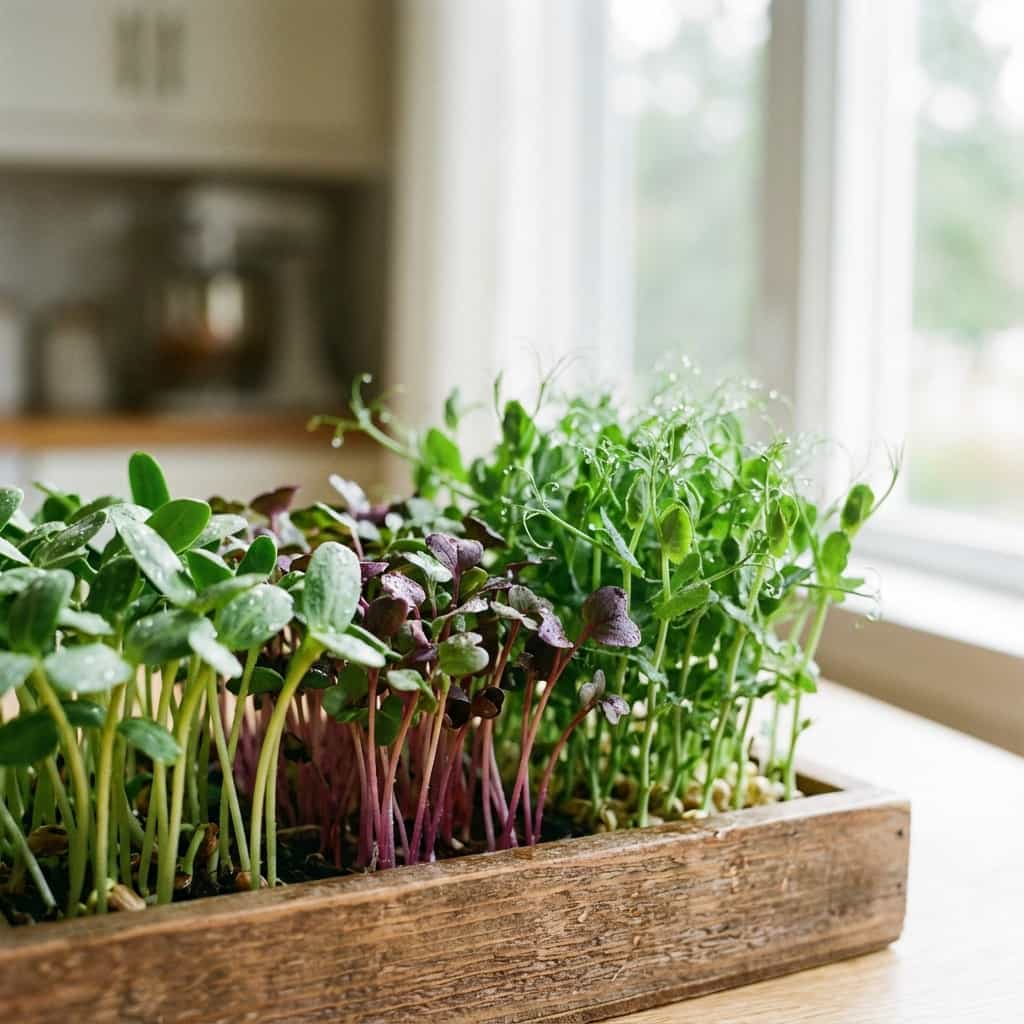
What "Leggy" Actually Means
Legginess — technically called etiolation — is a plant's programmed response to insufficient light. When a seedling perceives low light intensity, it redirects energy away from leaf development and into stem elongation, trying to grow taller and out of the shade.
The result is visually obvious: pale or yellowish stems that are disproportionately long, with small or underdeveloped leaves that often flop over under their own weight.
Diagnosing the Stage
The cause of legginess depends on when it appears:
During Blackout (Days 1–4)
This is expected and correct. Seeds in the blackout phase should be elongating toward the light — this is normal etiolation doing its job. A 2–4 cm stem at the end of blackout is a sign that germination went well, not a problem.
Action: None needed. Move to light on schedule.
Immediately After Moving to Light (Days 4–6)
Some stretch right after coming out of blackout is normal. But if the stems continue elongating rapidly without thickening, and leaves don't fill out within 24–48 hours of light exposure, the light is insufficient.
Common causes:
- Light source too far from the canopy
- Light intensity too low (wrong fixture or bulb type)
- Natural windowsill light that is indirect or north-facing
- Too many trays competing for a small light footprint
Mid-Growth Stretch (Days 5–10)
If stems were compact after the blackout phase but then started stretching mid-growth, something changed — or a hidden issue became visible as the canopy lifted above obstructions.
Common causes:
- Canopy has grown into a less-lit zone (light is too high)
- Light timer shortened or malfunctioning
- Uneven tray placement (edge trays getting less light)
How to Fix It
1. Reduce the Distance to Your Light Source
This is the most effective immediate fix. Most grow lights are effective at 10–30 cm above the canopy, and LED panels need to be closer than most growers assume. Lower your light or raise your trays.
Test: Hold your hand at canopy level. If you can barely feel warmth from a T5 fluorescent, it's too far. LEDs produce less heat, so distance alone is a poor proxy — use a PAR meter app or measure in lux.
2. Increase Daily Light Hours
The minimum for microgreens is 12 hours per day. For compact, vigorous growth, 16 hours is better. Most grow lights paired with a basic timer can achieve this easily.
3. Upgrade Your Light Source
Natural window light is inconsistent and often insufficient — seasonal changes, weather, and building shadows all affect output. If you're relying on a window:
- South-facing windows (Northern Hemisphere) are the best option
- East or west-facing is marginal — usable in summer, inadequate in winter
- North-facing windows are not suitable for growing compact microgreens
For a reliable alternative, a single T5 or T8 fluorescent strip (4000–6500K) or a dedicated LED grow light can support 2–4 standard trays reliably year-round.
4. Rotate Trays Daily
If some trays are consistently further from the light than others, rotate positions daily so all trays receive equal light over time.
5. Provide Physical Support During Recovery
If a tray of legged microgreens is otherwise healthy, you can press the stems gently to make them stand upright — many will strengthen and correct themselves once light is adequate. A thin layer of extra growing medium around the base can also help support weak stems.
Can Leggy Microgreens Be Saved?
Partially. Once a stem has elongated, that cell growth is permanent. But adequate light will:
- Stop further elongation immediately
- Trigger chlorophyll production, deepening the pale color to green within 24–48 hours
- Support leaf development and eventual recovery of the canopy
For a tray that's only mildly affected, recovery is complete. For severely stretched trays where stems have already flopped and are starting to rot at the base, recovery is unlikely — start fresh with better light conditions.
Prevention Checklist
- Light source within 15–25 cm of tray surface
- Timer set for 16 hours on / 8 hours off
- Light intensity verified across the full tray footprint (no dark edges)
- Trays rotated every 1–2 days
- Blackout period limited to 3–4 days maximum for most varieties
Variety-Specific Notes
| Variety | Stretch Tendency | Notes |
|---|---|---|
| Radish | Low | Fast-growing; bounces back quickly |
| Basil | High | Very light-hungry; minimum 16 hours recommended |
| Arugula | Medium | Can stretch in winter if window-grown |
| Pea shoots | Low | Tolerates lower light better than most |
| Sunflower | Medium | Heavy seeds; stems need support if leggy |
| Cilantro | High | Slow-germinating; needs strong light to develop compactly |
Legginess is rarely a dead end. Identify the light gap, fix it, and your next tray will grow exactly how it should.